“The cosmos is all that is or ever was or ever will be.”
— Sagan, C. (1980). Cosmos. Random House.
You may have heard the phrase, “We are made from stardust,” and that phrase isn’t quite far from the truth. You see, billions of years ago, a little after “The Big Bang”, the first generation of stars was born. These stars were 50 times greater than our sun and consisted of a slurry of gases composed primarily of hydrogen and helium. Eventually, these elements began reacting with each other. They began to undergo nucleosynthesis – “The production of chemical elements from simpler nuclei, especially hydrogen, during the early phases of the universe and within stars” (Nucleosynthesis | Stellar, Fusion & Hydrogen, 2025). This process produced heavier elements, such as carbon, oxygen, silicon, and other metals.
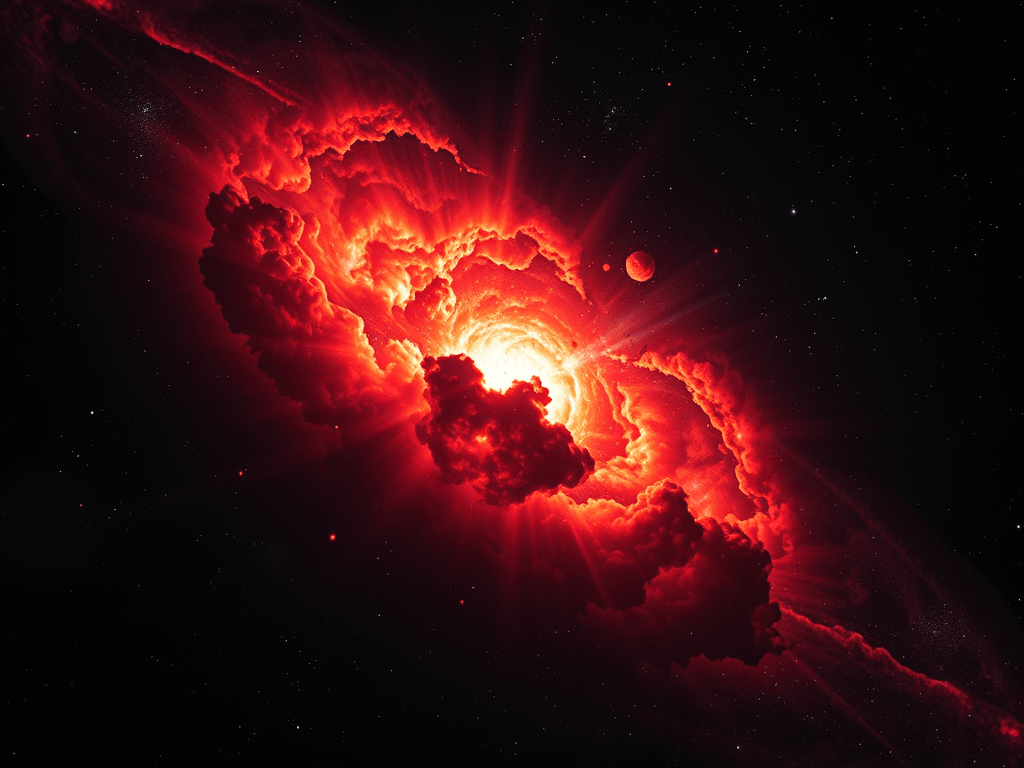
The catch with this cycle, however, lies within the star’s inability to burn long enough for more complex elements to form. You see, these stars were absolutely MASSIVE! In return, they burned through their fuel quite quickly. When a star’s fuel runs out, it goes through what is called a supernova. A supernova is essentially a huge explosion at the end of a star’s life that disperses any elements lingering outside of its iron core. This dispersion is due to the release of the star’s gravitational energy, which is so intense that it’s equivalent to more than the Sun’s entire lifetime energy output in seconds. This shockwave is so strong, it produces even heavier elements like gold, uranium, and thorium through rapid neutron capture. All of which get slammed through our interstellar medium of gases, dust, and plasma. Over millions of years, the gravitational pull of space pushes these floating molecules into the cloud-like structures we know as nebulae. When another shockwave of force hits these nebulae, they essentially collapse into themselves because the uptake in density finally allows gravity to do something about them. This external force of pressure heats the gases to about 10 million kelvin, and when temperatures reach this high, it slows the collapse. However, molecules like carbon monoxide, dihydrogen, and dust particles cool down the reaction and continue it on its way to collapse. Through this collapse, nuclear fusion occurs. Hydrogen and helium are smashed together and create the light we see shining in the sky. The continuation of this cycle gave us the elements we see on our periodic table – the fundamental building blocks of life as we know it. So yes, we are a product of chemical reactions that occurred millennia ago through the death and rebirth of a star.
Humans share this cycle. We, too, are born from a combination of passed-down genes that give us our own individual ‘properties’. When we die, our cells and other bodily makeups decompose their structure and revert to their most basic elements. Elements like nitrogen, methane, carbon, oxygen – the list goes on! And each one floods the ground around us to be recycled into a multitude of things. Humans, animals, plants, anything that can get to your flesh first. The same is true for planets; they, too, work on a first-come, first-serve basis. This is why Jupiter is the largest planet in our solar system. Formed first after the Sun, it gobbled up most of the gas that was left over from the Sun’s feeding-frenzy. Then Saturn formed and slowed its outrageous diet, forcing Jupiter into a corner of leftovers at the buffet. This created a huge gap in the gas our solar system was formed in and essentially starved it and prevented it from growing any further. This is where the phrase “Jupiter is a failed star” came from. If Jupiter were to consume just a little more, it would’ve turned into a star just like our sun.
Now, you may be asking how this relates to us besides our growing obesity and wealth gap crisis. Well, you see, if Jupiter didn’t gobble up any of the gas from the cloud, and the sun was able to go crazy, it just might’ve been able to create a core so massive its supernova would have left a pulsar. A pulsar is the non-shining core of a neutron star (a very, very large star) that got compressed during its supernova but didn’t completely implode. It’s essentially the dying ember of a fire, often called a zombie star because it’s “dead.” What separates a pulsar from any ordinary meteorite floating around in space is the uncanny amount of energy it gains from its supernova. This is due to the principle of conservation of angular momentum. When something is compressed, inertia is decreased, which allows the object to spin faster. Think about it like an ice skater closing their arms while spinning and getting faster.
What’s interesting about Pulsars is the fact that they’re still contained by their magnetic fields. This creates a sort of lighthouse effect because their magnetic poles “…act like fountains [and] can escape value for charged particles that get trapped in the star’s enormously strong magnetic field” (Pulsars Astronomy – National Radio Astronomy Observatory, n.d.). So, as this gigantic ball of energy spins at unfathomable speeds, particles are released in the direction of their poles in the form of ‘pulses’. The expulsion of these particles occurs hundreds of times during a single second, which is faster and more precise than atomic clocks! From a metaphorical stance, this can look like a beating heart – one of the most blatant forms of life or consciousness in our universe. Though this process, no matter how uncannily precise, is not the result of direction or any kind of motivation, but rather a crude display of physics pushing and pulling. Reacting to an event that occurred and nothing else. An object will stay at rest until acted upon by an external force.
By now, you may be pointing out the fact that this differs from humanity because we do have direction with motivation, but do we really?
“Entropy is a measure of the disorder or randomness in a system. In thermodynamics, it quantifies the amount of energy in a system that is no longer available to do work.” – Zumdahl & Zumdahl, Chemistry (10th ed.)
To this definition, living things seemingly defy entropy. Our cellular makeup, nerves, and processes all build order. Ironically enough, this actually increases entropy! Let’s dig into why.
“The total entropy of a (thermodynamically) closed or isolated system never decreases; it either increases or remains constant over time.”
So to reiterate, life seems to defy this, right? We eat, we think, we build muscle, we grow, we reproduce! Humans are consistently multiplying and creating. But we also release… Heat, carbon dioxide, urine, feces, energy, and other chemical makeups from dead cells. Why is this significant? Glad you asked! Entropy is also defined as a lack of order or predictability. A gradual decline into disorder. To space, humans are entropic for the functions we mentioned above, or rather, our distinction between life and inanimate objects. But it doesn’t stop there because humans are actually entropic to each other. Each body differs in chemical processes and genealogical makeups, just like how our fingerprints are unique to us. Reproduction isn’t proof of our order…it’s an acceleration of entropy. And what were we created from? Stardust. Our universe is rapidly expanding as we speak, and we are one of its more fine-tuned products.
So, where is this energy going? What is the purpose of this spiral into entropy?
Our universe is heading toward thermal equilibrium, which is essentially where all usable energy is spread so thin that it can’t do it anymore (leaving us in the same place we were when the Big Bang occurred). This is called the heat death of the universe. No stars, no thought, no motion. Just flat empty sameness. We are not here to survive. We are here to burn the fuel of existence faster. No heaven, no hell, your consciousness is not a divine sanctuary. Our brains are energy hogs. Using a whole 20% of our body’s energy capacity to fire electrical signals like pulsars across billions of neurons. Every moment that we are alive, our mind is breaking down ordered molecules into waste and radiating heat like the furnace of a dying star. So why do we exist? It’s not because the universe wants us to, no, never that. We exist because we are the most efficient way to spread entropy faster. The complexity that we create within society only generates more entropy and releases more heat as we collapse. A Pulsar doesn’t emit heat because it wants to; it has to. Just like us. To our core, we, too, are nothing but a crude product of physics. As you read this, you are releasing heat and bringing us one step closer to the great heat death. You can’t stop it, and if you try, you’ll only burn brighter and accelerate the process.
We are created from the same compounds of stars, so it only makes sense for us to die like them, too. We may not be large enough to decay into a pulsar or a black hole, but we certainly are composed of enough matter to decompose and disperse.
We often speak of inanimate objects as inferior due to their lack of consciousness. But as we’ve discussed, consciousness is simply a greater state of entropy. So they may be lesser in that aspect, sure, but not exempt. Even rocks absorb and release energy. They are constantly interacting with our environment, even if it’s so slow that we will not see it in several lifetimes. Earth is at about 300 Kelvin, and the cosmic microwave background stands at 7.1 Kelvin. So we have quite a while before thermal equilibrium is reached and every particle of matter is frozen into dispersed arrangements at the end of time. Matter, too, will also break down over a few eons, not just heat. Proton decay is predicted, but not confirmed (and pretty much impossible to confirm for reasons I hope you can infer). Eventually, atoms will fall apart and essentially evaporate across our ever-growing universal boundary. Nothing, not even black holes, will survive this. They, too, will decompose via Hawking Radiation. No stars, no heat, no matter. Just a thin, dark smear of low-energy photons. We, along with every other object within our universe, are not dead – we are dying.
So the next time you let your ego (a heat-releasing process) tell you that inanimate objects are somehow lesser than us, think a little harder so you release more heat and put all of us out of our misery a little faster.
We name planets like our own children. We understand that each planet, each star is unique and its own individual “being.” And yet, we somehow manage to classify them as stone-cold pillars of OUR creation, stepping stones that lead us to some divine presence of self, purpose we label consciousness. A concept that if planets possessed it, they’d use it to laugh at us. Because all it does is kill us faster, and we think we’re special for it.
Stars are born. Stars cannibalize other stars to consume their energy. Stars metabolize. Stars emit heat. Stars emit energy signals. Stars have magnetic fields. Stars have fractals. Stars have feedback loops. Stars die. Do you know who else possesses these traits? Us. As above, so below. We really aren’t that different, are we?
A little bonus in case your ego still has you wrapped up in a god complex.
In the context that humans are more advanced on their accelerated entropic scale, you may assume we reside at the top of the cosmic food chain in heat dispersion. However, that’s simply not true anymore. Our own devices, physical devices, that we have created, are far more efficient at consuming and decaying heat and energy than us. Ironic, yeah? We dug our own graves and created our own supernova. Innovation, or suicide? Human nature isn’t really human at all.

 Asher Nation
Leave a comment